
Intersections Are Where Most Crashes Happen: Here Is Why
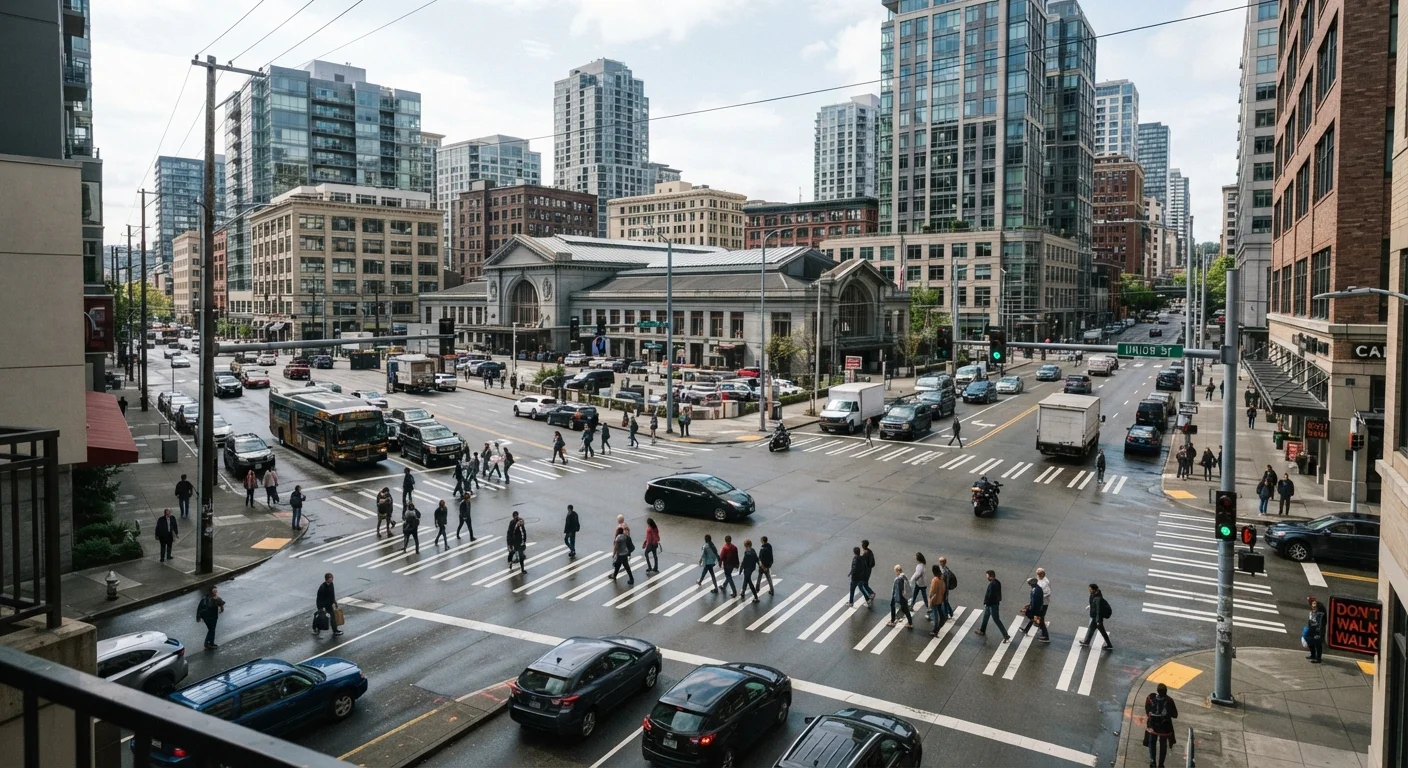
Photo credit: TrendingFaqs.com
In this article
A large share of traffic crashes occur at intersections. Learn the common causes and the habits that reduce your exposure.
Key Takeaways
- About half of all traffic injury crashes in the United States are linked to intersections.
- Left turns are consistently more dangerous than right turns because they cross oncoming traffic.
- Distraction, misjudging gaps, and running red lights are the three most common driver errors at intersections.
- Slowing before a green light and scanning cross-traffic before entering are habits that reduce exposure.
- Pedestrians and cyclists are most at risk at intersections, so extra scanning matters even when you have the right of way.
Why intersections concentrate so much risk
Intersections are where different streams of traffic, pedestrians, and cyclists must share the same physical space at the same time. Every vehicle approaching from a different direction is traveling on its own path, at its own speed, with its own driver making independent decisions. The more variables converge in one spot, the greater the chance that one of those decisions is wrong, or that two drivers misread the same situation differently.
The Federal Highway Administration has reported that intersection-related crashes account for roughly 40 to 50 percent of all injury crashes in the United States. That figure has held up across many years of data. It is not that intersections are uniquely poorly designed, though some are. The concentration of risk comes from the nature of what intersections ask drivers to do: judge speed, distance, and intent from multiple directions simultaneously, often while moving.
For new drivers especially, that complexity is easy to underestimate. See our guide to safety habits new drivers often skip for more on why intersections deserve particular attention early in a driving career.
The errors that cause most intersection crashes
Three driver behaviors account for the large majority of intersection crashes.
Running red lights and stop signs. A driver who enters an intersection after the signal has changed, or without stopping at a sign, creates a direct conflict with cross-traffic that has already been given the right of way. Angle collisions that result from this error are among the most severe crash types because the impacted vehicle is struck on its side, where there is far less structural protection.
Misjudging gaps during turns. Left turns are the clearest example. Crossing oncoming traffic requires an accurate read of vehicle speed and distance. Drivers routinely underestimate how fast an approaching car is moving, particularly at higher-speed roads. That miscalculation leaves the turning vehicle sitting in the path of oncoming traffic.
Distraction. A driver who glances at a phone for two seconds while approaching an intersection at 30 mph travels roughly 88 feet without looking at the road. At that speed, a pedestrian stepping off the curb or a car rolling into the intersection from a side street becomes a hazard with almost no time to react. Distraction is not limited to phones; adjusting a radio or looking at a passenger has the same effect.
Pause before you accelerate on green
A brief pause when your signal turns green lets any red-light runners clear before you enter. You do not need to sit for several seconds. A quick left-right scan before pressing the accelerator is enough. This habit is most useful at wide intersections where cross-traffic enters at higher speeds.
What actually helps
Concrete habits, applied consistently, reduce exposure at intersections. None of these require advanced training.
- Slow before a green light. If you have been waiting at red and the signal turns green, pause briefly and scan cross-traffic before accelerating. A car running a late red is most dangerous in that first second after your signal changes.
- Keep your wheels straight while waiting to turn left. If a car hits you from behind while your wheels are turned, the impact pushes your vehicle into oncoming traffic. Wheels straight keeps you in your lane until you have a clear gap and begin the actual turn.
- Look left, right, and left again before entering any uncontrolled intersection. Vehicles approaching from your left are the first potential conflict, which is why you check that direction twice.
- Give pedestrians and cyclists more time than you think you need. A pedestrian in a crosswalk may be moving more slowly than you expect, and a cyclist may be approaching faster than they appear.
Following distance also matters on the approach. A driver tailgating into an intersection has almost no room to stop if the car ahead brakes for a yellow. See our explanation of the two-second rule for how to build that buffer in any conditions.
School zones and work zones near intersections add another layer of unpredictability, with children and workers often moving close to traffic.
Intersections compared to other road types
It is worth noting that intersections are not the only place where serious crashes occur. Rural two-lane roads have higher fatality rates per mile traveled, largely because crashes happen at higher speeds with less emergency response nearby. See our article on rural road driving risks for a closer look at that environment.
Highway merges are another concentrated risk zone, where drivers misjudge relative speed while changing lanes. Our guide to merging safely covers the specific skills that apply there.
Intersections stand apart because they affect almost every driver on almost every trip. A driver who commutes through a city may pass through dozens of intersections daily. The sheer frequency of exposure means that even a small improvement in intersection habits compounds into a meaningful reduction in crash risk over time.
Frequently Asked Questions

Author
Cars Editorial Team
Cars Editorial Team is the collective byline for our editorial team and contributor network. Articles published under this byline or an editorial pen name are researched, written, and reviewed according to our editorial standards for clarity, consistency, and independence before publication.
View all articles →