
Reading Your Tires: Sidewall Codes, Wear Patterns, and Rotation Logic
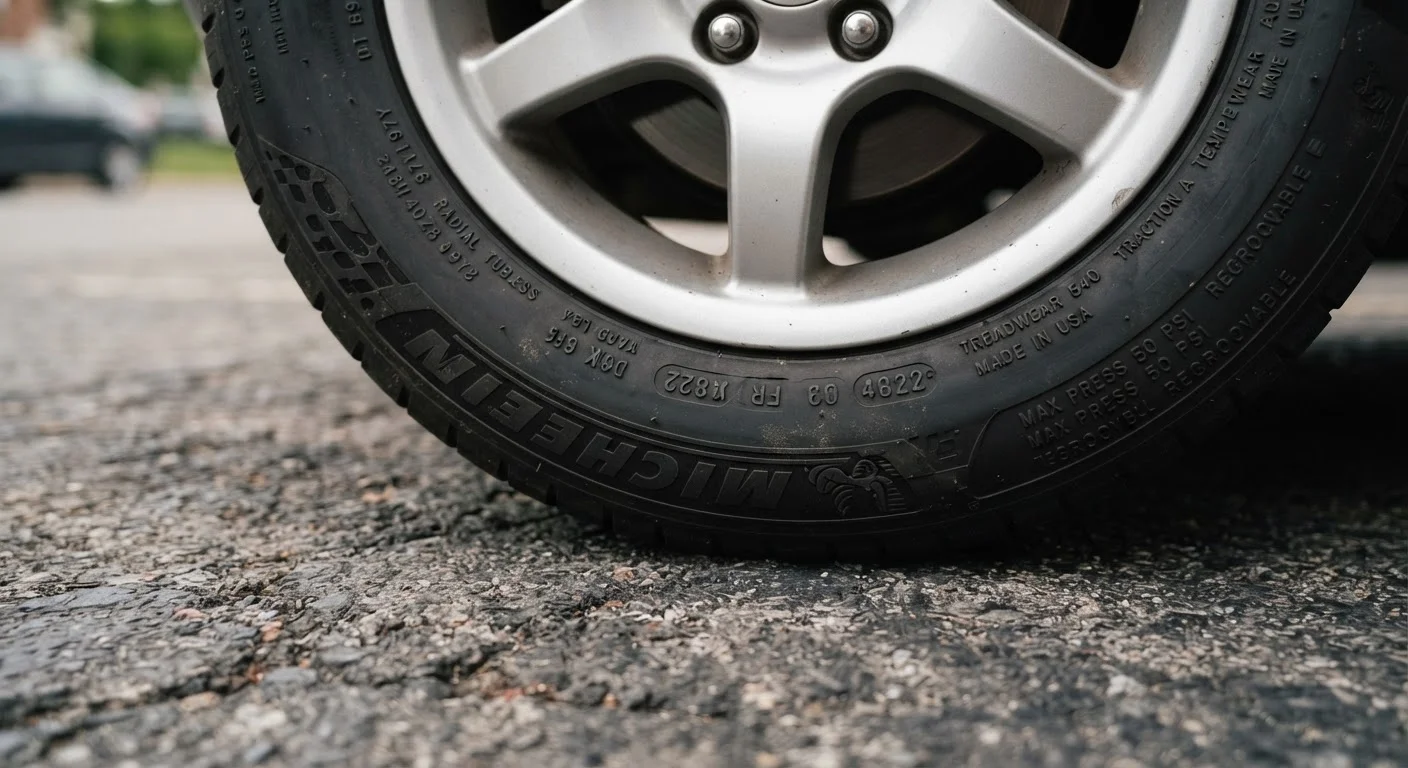
Photo credit: TrendingFaqs.com
In this article
Your tires communicate a lot if you know where to look. This reference covers sidewall markings, uneven wear causes, and rotation intervals.
How to read a tire sidewall
The string of letters and numbers molded into your tire's sidewall is not decorative. It contains the information you need to buy the correct replacement, understand the tire's limits, and verify that what's on your car matches what your vehicle manufacturer specifies.
A typical sidewall code looks like this: P215/65R17 98H. Here is what each part means:
- P stands for passenger vehicle. You may also see LT (light truck) or no letter at all on metric-sized tires.
- 215 is the tire's cross-sectional width in millimeters.
- 65 is the aspect ratio, meaning the sidewall height is 65% of the width.
- R indicates radial construction, which is standard on nearly all modern passenger tires.
- 17 is the wheel diameter in inches the tire is designed to fit.
- 98 is the load index, a number that maps to a maximum weight each tire can support. A load index of 98 corresponds to about 1,653 pounds per tire.
- H is the speed rating. H-rated tires are designed for sustained speeds up to 130 mph under controlled conditions. Speed ratings run from L (75 mph) up through Y (186 mph).
The sidewall also shows a DOT code (Department of Transportation compliance stamp), followed by a production date code. The last four digits of that sequence tell you the week and year of manufacture: for example, 3222 means the 32nd week of 2022. Tires older than six years warrant a close look regardless of tread depth, and most manufacturers advise replacing tires at ten years regardless of condition.
For a complementary look at the two numbers that matter most day-to-day, see our guide to tire pressure and tread depth.
Aspect ratio
The ratio of a tire's sidewall height to its cross-sectional width, expressed as a percentage. A lower number means a shorter sidewall.
Load index
A number on the sidewall that corresponds to the maximum weight each tire can safely carry. Higher numbers indicate higher load capacity.
Speed rating
A letter code indicating the maximum sustained speed a tire is designed to handle under controlled conditions. It is not a recommendation to drive at that speed.
Camber
The inward or outward tilt of a wheel when viewed from the front of the vehicle. Incorrect camber is a common cause of one-sided tire wear.
Toe alignment
The degree to which tires point inward (toe-in) or outward (toe-out) relative to the vehicle's centerline. Incorrect toe causes feathered wear and can affect straight-line stability.
Directional tire
A tire with a tread pattern designed to rotate in one direction only, usually marked with an arrow on the sidewall. These tires cannot be swapped side-to-side during rotation.
DOT code
A compliance and identification code required by the U.S. Department of Transportation. The last four digits indicate the week and year the tire was manufactured.
What wear patterns tell you
Uneven wear is your tire's way of flagging a problem. The pattern of wear narrows down the likely cause.
Center wear
If the center of the tread is more worn than the edges, the tire has been consistently over-inflated. Excess pressure causes the center of the tread to contact the road more than the shoulders.
Edge wear
Wear concentrated on both outer edges (with the center relatively fresh) points to chronic under-inflation. The tire bows outward, putting more load on the shoulders. Checking and adjusting pressure monthly is the most direct way to prevent this.
One-sided wear
Heavy wear on only one shoulder, inner or outer, usually means the wheel camber (the inward or outward tilt of the wheel when viewed from the front) is out of spec. This is an alignment issue. Wheel alignment can drift from road impacts and normal use, and a one-sided wear pattern is one of its clearest symptoms.
Cupping or scalloping
Cupped tires show a wavy, uneven surface across the tread, often described as scooped-out patches. This typically means a worn shock absorber or strut is allowing the tire to bounce rather than roll smoothly. Cupping also creates a noticeable humming or thumping noise at speed.
Feathering
Feathered wear means the tread blocks are rounded on one side and sharp on the other, like fins. This is usually a toe alignment problem: the tires are angled slightly inward or outward relative to the direction of travel.
Any of these patterns is a reason to have your alignment and suspension checked promptly. Continuing to drive on a tire with a diagnosed alignment issue wears out the tire faster and can affect handling. If you notice noise or pulling alongside unusual wear, also rule out brake-related causes before assuming it is purely a tire problem.
Rotation intervals and patterns
Rotating tires moves them to different positions on the vehicle so wear spreads more evenly across all four. Front tires on front-wheel-drive vehicles carry the braking, steering, and acceleration load simultaneously, which wears them faster than the rears. Rotation balances that out and extends the overall set's life.
| Recommended rotation interval | Every 5,000 to 7,500 miles (Varies by vehicle and tire manufacturer; consult your owner's manual) |
| Typical tire replacement age limit | 6 to 10 years from manufacture date (Most tire manufacturers and vehicle OEMs) |
| DOT date code location | Last 4 digits of the DOT sequence on the sidewall |
| Speed rating H | Up to 130 mph sustained (Under controlled test conditions, not a driving recommendation) |
| Load index 98 | Approximately 1,653 lbs per tire (Per standardized tire industry load index tables) |
| Most common rotation pattern (FWD) | Forward cross |
How often to rotate
Most vehicle manufacturers recommend rotating tires every 5,000 to 7,500 miles, though some extended-life tires and certain vehicle types specify different intervals. Your owner's manual is the authoritative source for your specific vehicle. Many drivers rotate at every other oil change as a convenient reminder.
Common rotation patterns
The correct pattern depends on whether your tires are directional or non-directional, and whether your vehicle has a full-size spare that can be included.
- Forward cross (front-wheel drive): front tires move straight back; rear tires cross to the opposite front positions.
- Rearward cross (rear-wheel drive and four-wheel drive): rear tires move straight forward; front tires cross to the opposite rear positions.
- X-pattern: all four tires swap diagonally. Used on some front-wheel-drive vehicles when front and rear wear is very different.
- Side-to-side: used only on directional tires (tires with a one-way tread pattern marked with an arrow on the sidewall). These cannot cross axles, so they move only front-to-rear on the same side.
Staggered fitments, where the rear tires are wider than the fronts, often cannot be rotated front-to-rear at all. In those cases, check the owner's manual for approved alternatives or side-to-side rotation if the tires are non-directional.
Keeping a record of each rotation, including mileage and which pattern was used, makes it easier to spot irregular wear early. A simple maintenance log pays off when you're trying to track down a developing problem or plan your next service.

Author
Cars Editorial Team
Cars Editorial Team is the collective byline for our editorial team and contributor network. Articles published under this byline or an editorial pen name are researched, written, and reviewed according to our editorial standards for clarity, consistency, and independence before publication.
View all articles →