
Understanding Wheel Alignment and Why It Drifts Over Time
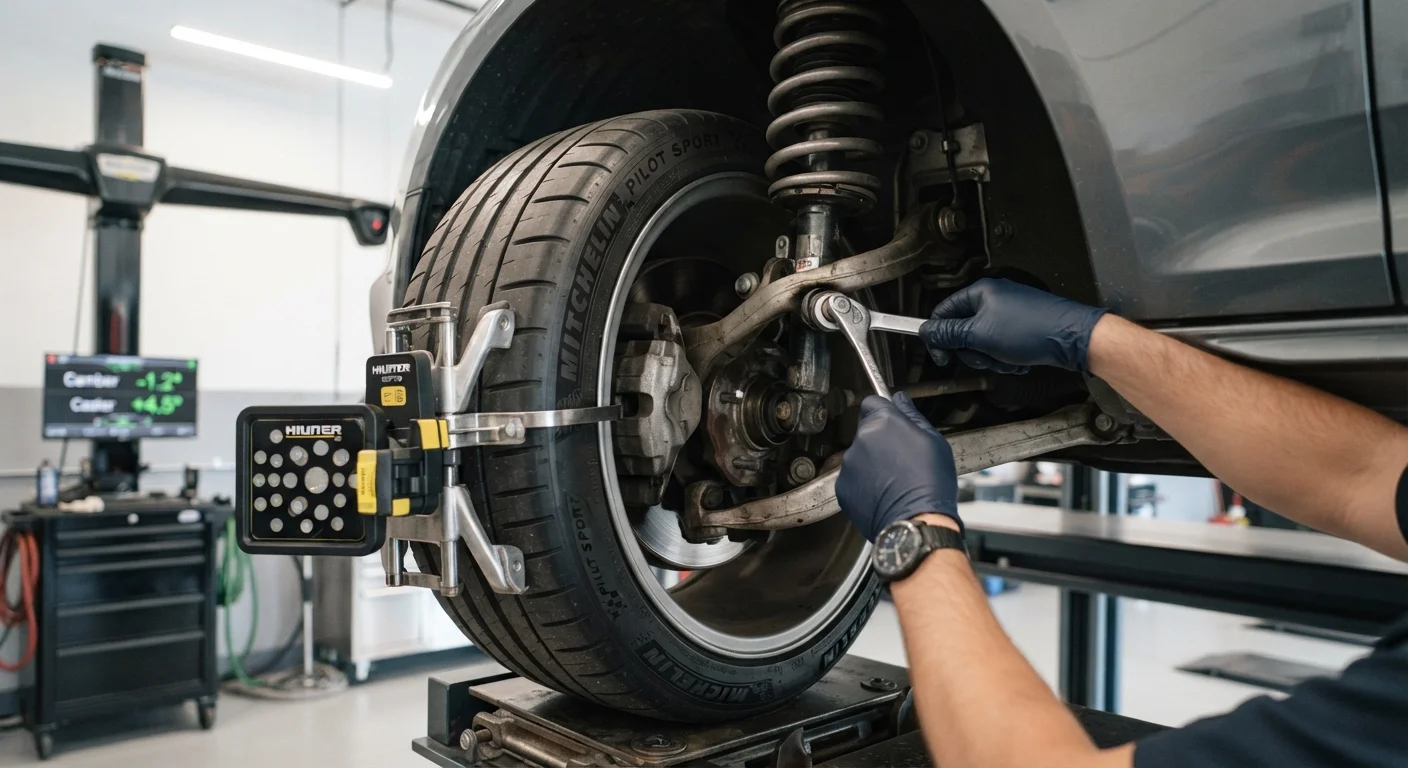
Photo credit: TrendingFaqs.com
In this article
Wheel alignment affects tire wear, fuel efficiency, and handling. Learn what knocks it out of spec and what symptoms to watch for.
Key Takeaways
- Alignment drifts gradually from normal driving and suddenly from impacts like potholes or curbs.
- The clearest warning signs are a car that pulls to one side and uneven tire wear.
- Poor alignment accelerates tire wear and can reduce fuel efficiency.
- A qualified mechanic should measure and adjust alignment with a dedicated alignment machine.
- Most vehicles benefit from an alignment check once a year or after any significant suspension impact.
What wheel alignment actually means
Your car's four tires do not sit perfectly flat and parallel by accident. Engineers specify exact angles for each wheel position to balance handling, stability, and tire longevity. Alignment is the process of confirming and correcting those angles using a machine that reads each wheel's position simultaneously.
The three angles that matter most are camber, toe, and caster. Camber is how much the top of the tire leans in or out when you look at the car head-on. A small amount of negative camber (top leaning inward) is normal on many vehicles. Too much in either direction puts uneven pressure on the tread. Toe describes whether the fronts of the tires point toward each other (toe-in) or away from each other (toe-out) when viewed from above. Caster is the angle of the steering pivot axis and affects straight-line stability and steering return. Most drivers never need to memorize these terms, but understanding that each one has a measurable correct range explains why alignment is a precise, shop-level task.
Why alignment drifts out of spec
Alignment does not stay perfectly fixed forever. Several forces work against it over time.
Sudden impacts are the most obvious cause. Hitting a deep pothole at speed, striking a curb while parking, or going over a speed bump too fast can move suspension components enough to change an alignment angle immediately. You may notice the car pulling right after one of these events.
Normal road use also causes gradual drift. Worn ball joints, tie rods, and control arm bushings all allow small amounts of play that accumulate over time. As rubber bushings age and soften, the precise geometry the manufacturer set begins to shift. Vehicles in regions with rougher roads or colder climates tend to see faster wear on these parts.
Vehicle modifications matter too. Installing a lift kit, lowering springs, or even different-size tires without a corresponding alignment adjustment almost always moves angles outside the factory spec.
Four-wheel vs. two-wheel alignment
Not every vehicle needs all four wheels adjusted. On many trucks and rear-wheel-drive cars with a solid rear axle, only the front wheels are adjustable. A four-wheel alignment is still worth requesting on vehicles with independent rear suspension, since rear angles affect how the car tracks and how evenly rear tires wear. Ask your technician which type applies to your vehicle.
Symptoms that suggest a problem
Alignment issues rarely announce themselves with a warning light. Instead, watch for these signs:
- Pulling to one side: The car drifts left or right when you drive on a flat, straight road with a light grip on the wheel.
- Off-center steering wheel: The wheel sits noticeably crooked when the car is going straight.
- Uneven tire wear: One edge of a tire wears faster than the other, or front tires wear differently from rear tires. Tire wear patterns tell a specific story about what is happening mechanically.
- Loose or wandering steering: The car does not track predictably and requires constant small corrections.
These symptoms can overlap with other issues such as a low tire or worn shocks, so a shop inspection confirms whether alignment is actually the cause.
What happens if you ignore it
Driving on misaligned wheels is not immediately dangerous in the way a brake failure is, but the costs add up. Tire wear is the most direct consequence. A tire scrubbing at even a small angle loses tread faster, and replacement tires are a significant expense. The fuel efficiency impact is smaller but real: more rolling resistance means more fuel burned per mile.
Handling precision also suffers. A car that pulls or wanders is harder to keep in its lane, which matters most in emergency situations where precise steering control counts. Suspension components themselves can wear faster when geometry is off, since forces are not distributed the way the design intended.
Getting alignment checked and corrected
Alignment is measured and adjusted on a machine that attaches sensors to each wheel and reads all angles at once. A printout shows where each angle falls relative to the manufacturer's spec and what the technician adjusted it to. Ask to see this printout after any alignment service.
A standard four-wheel alignment covers all four corners. Some vehicles with a non-adjustable rear suspension (common on older or simpler designs) only allow front adjustment, but a technician should still measure the rear to check for damage. If rear angles are out of spec and not adjustable, the likely cause is a bent or damaged component that needs replacement.
Plan on an alignment check once a year for most vehicles, and after any significant impact to the suspension. Pairing it with a tire rotation visit is efficient since the tires come off anyway. For more on how wear patterns and rotation relate to alignment, see how tire wear and rotation connect.
Frequently Asked Questions

Author
Cars Editorial Team
Cars Editorial Team is the collective byline for our editorial team and contributor network. Articles published under this byline or an editorial pen name are researched, written, and reviewed according to our editorial standards for clarity, consistency, and independence before publication.
View all articles →