
Savings Goals by Life Stage: From First Job to Retirement Runway
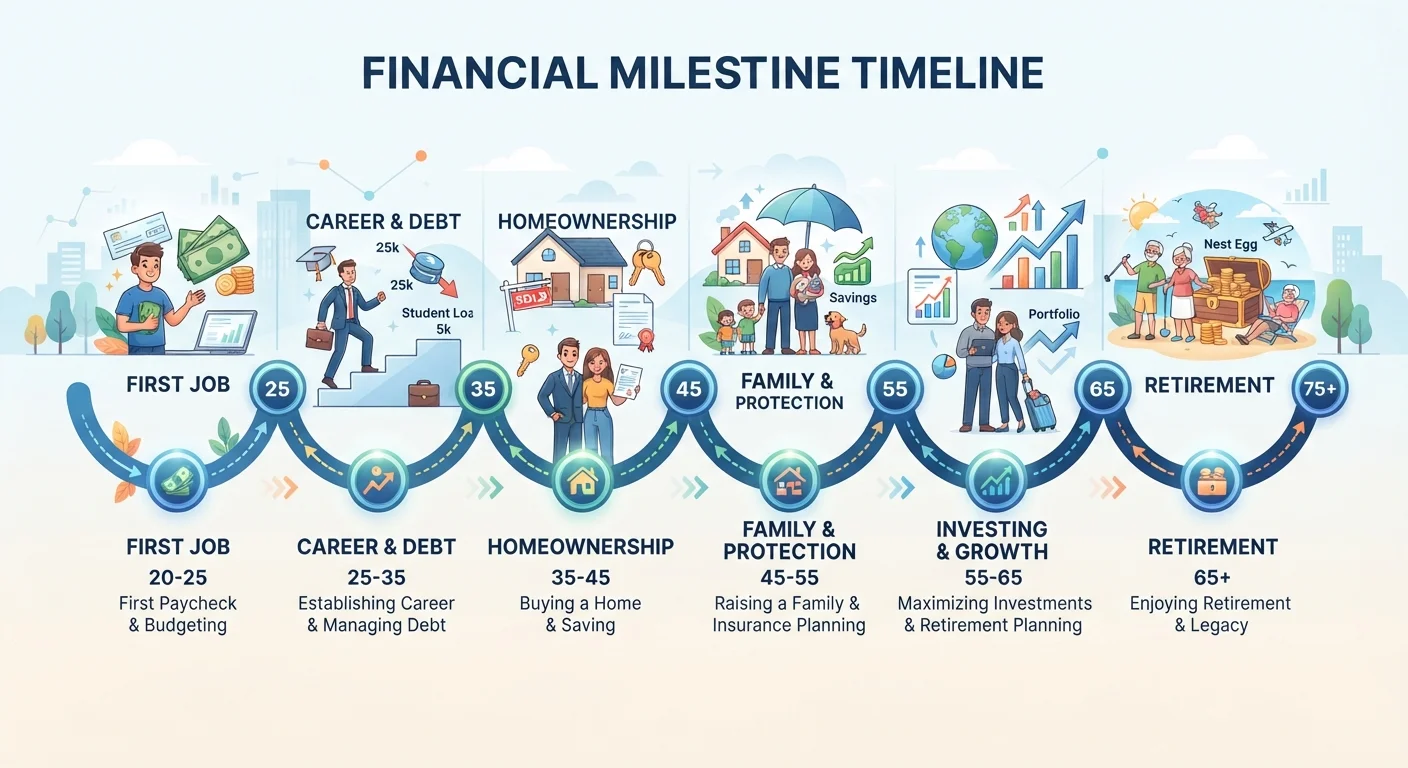
Photo credit: TrendingFaqs.com
In this article
Financial priorities shift over time. This guide maps common savings milestones across early career, mid-life, and pre-retirement years.
Key Takeaways
- Savings priorities change meaningfully between your 20s, 40s, and 60s.
- An emergency fund should come before aggressive investing at any life stage.
- Carrying high-interest debt alongside savings usually costs more than it earns.
- Employer retirement matches are effectively guaranteed returns and worth capturing first.
- Pre-retirement years call for shifting focus from accumulation to protecting what you have built.
Why life stage matters for savings
A 24-year-old with a first paycheck and a 58-year-old with seven years until retirement face almost nothing in common financially, yet both are frequently given the same generic advice: spend less and save more. That advice is not wrong, but it is incomplete. The what to save for and the order in which to pursue goals changes significantly as income, responsibilities, and time horizons shift.
Life stage also determines how much time compound growth has to work. Money invested at 25 has roughly 40 years to grow before a typical retirement age. The same dollar contributed at 55 has 10. That gap shapes everything from how aggressively to invest to whether paying down debt should take priority over building a portfolio.
This guide treats each stage honestly, including the friction of everyday debt, inconsistent income, and competing financial demands that most people actually face.
This article is for general informational and educational purposes only. It is not personalized financial, investment, tax, or legal advice. Consult a qualified financial adviser or accountant before making decisions about your own circumstances.
Early career: building the foundation
The first years of earning are less about wealth-building and more about avoiding the mistakes that compound against you. Three goals tend to matter most in this phase.
Emergency fund first
Before directing money toward investments or aggressive debt payoff, build a cash cushion. Most personal finance practitioners point to three to six months of essential expenses as a reasonable target, held in a liquid, accessible account. Without this buffer, any unexpected expense, a car repair, a medical bill, a job gap, forces you to borrow, which erodes financial stability faster than investing builds it.
If you are working with a limited income, even a modest $500 to $1,000 starter fund reduces the likelihood of going deeper into debt when something goes wrong. See practical strategies for saving on a tight budget if income is the main obstacle.
Capture employer retirement matches
If your employer offers a 401(k) match, contribute at least enough to get the full match before doing anything else with discretionary income. A 50% or 100% match on your contribution is a guaranteed return that no investment product can reliably replicate. Not capturing it is, in plain terms, leaving compensation on the table.
Managing early debt
Student loans are common in this stage. The priority question, whether to pay them off aggressively or invest simultaneously, depends on the interest rate. Federal student loan rates below roughly 5-6% may not warrant prioritizing payoff over tax-advantaged investing, particularly when an employer match is available. Higher-rate private loans or credit card balances shift that calculus. For a structured way to think this through, see the framework for deciding between saving and debt payoff.
Set up automatic transfers to savings on payday, before discretionary spending has a chance to absorb the money. Even a small fixed amount builds the habit and the balance simultaneously.
Automation removes the decision point that most people fail at: choosing each month to save rather than spend. Behavioral research consistently shows that defaults drive outcomes more reliably than intentions.
Review your savings allocation whenever your income changes, not just once a year. A raise that never reaches savings is effectively a lifestyle inflation event.
Income increases are the most natural moment to raise savings rates without reducing take-home pay relative to what you had before, making the transition feel neutral rather than painful.
Mid-career: balancing competing priorities
Mid-career years, roughly the late 30s through early 50s, tend to bring higher income alongside more financial obligations: a mortgage, children, aging parents, and career transitions. Savings goals expand but so does the pressure on monthly cash flow.
Increasing retirement contributions
With a longer runway than pre-retirees but a shorter one than young earners, mid-career savers benefit from pushing retirement contributions above the employer match minimum. The IRS sets annual contribution limits for 401(k) accounts that rise periodically; checking the current limit and working toward it over time is a concrete goal rather than an abstract one.
College savings considerations
Parents funding college often use 529 plans, which offer tax-advantaged growth for qualified education expenses. The tension here is real: funding a child's education while also funding retirement is genuinely difficult on most incomes. Financial planners commonly note that retirement savings should take priority because students can borrow for college but retirees cannot borrow to fund their later years. That is not a dismissal of college savings; it is a sequencing principle.
Protecting income
Mid-career is also when disability insurance and adequate life insurance coverage matter most. A family depending on two incomes or a single earner faces meaningful financial risk if that income disappears. understanding insurance basics provides a starting point for thinking about coverage needs.
Lifestyle expenses tend to grow with income in this phase. Behavioral patterns, not just income levels, often determine whether savings keep pace. identifying spending triggers that quietly erode savings progress is worth reading if discretionary spending seems to absorb every raise.
Pre-retirement: the runway years
The decade or so before a target retirement date is when financial decisions carry the most immediate consequences. Mistakes made at 30 have time to correct. Mistakes made at 58 often do not.
The shift from accumulation to protection
Throughout earlier decades, the focus is on accumulating assets. In the pre-retirement phase, protecting what has been accumulated becomes equally important. That usually means gradually shifting a portfolio's asset allocation toward less volatile holdings, though the right mix depends on individual risk tolerance, other income sources, and timeline. A licensed financial adviser can model this for a specific situation.
Catch-up contributions
The IRS allows workers aged 50 and older to contribute additional amounts to 401(k) plans and IRAs beyond standard limits. These catch-up contribution provisions exist precisely for this stage and can meaningfully increase tax-advantaged savings in the final working years.
Estimating retirement income needs
A common planning reference is that retirees may need roughly 70-80% of pre-retirement income annually, though this varies considerably based on debt levels, health expenses, housing status, and lifestyle. Social Security benefit estimates are available through the Social Security Administration's online portal and should factor into any projection. Planning without those numbers produces guesswork rather than a plan.
Major purchases in these years, including vehicle decisions, carry financial weight that earlier earners can more easily absorb. how car ownership costs shift across life stages covers this intersection in more detail.
Debt and savings: finding the right balance
Debt does not disappear when savings goals appear. Most people manage both simultaneously for most of their adult lives, and the interaction between the two is where many plans fall apart.
High-interest consumer debt, credit cards carrying 20-25% APR, almost always costs more than a savings account or even a broad investment portfolio earns over the same period. Eliminating that debt before building beyond a basic emergency fund is typically the more efficient path.
Lower-rate debt, such as a fixed-rate mortgage, occupies a different position. Many people carry mortgage debt into retirement without it representing a crisis, particularly when home equity has built alongside it. The calculation depends on the specific rate, remaining term, and alternative uses of the money.
the full framework for weighing debt payoff against saving works through these trade-offs with practical criteria you can apply to your own numbers.
Adjusting when life does not go to plan
Job loss, medical costs, divorce, a business failure, or supporting a family member financially can set savings progress back by years. That is a common experience, not an exception, and most financial guidance underweights it.
The practical response is triage rather than paralysis. When a disruption occurs, the immediate priority is covering essential expenses and preventing high-interest debt from accumulating. Retirement contributions may need to pause temporarily. The emergency fund exists for exactly this purpose.
What matters over a working lifetime is the average savings rate, not what happens in any single year. Someone who saves steadily for 25 out of 30 years, with five disrupted years, will generally be in a far stronger position than someone who never started because the plan did not feel achievable.
building toward higher income over your career matters here too. Income growth over time is one of the most reliable paths to closing savings gaps, and career decisions made in early and mid-career affect the financial options available in the years before retirement.

Author
Finance Editorial Team
Finance Editorial Team is the collective byline for our editorial team and contributor network. Articles published under this byline or an editorial pen name are researched, written, and reviewed according to our editorial standards for clarity, consistency, and independence before publication.
View all articles →