
APR vs. APY: The Difference That Changes What a Rate Really Costs You
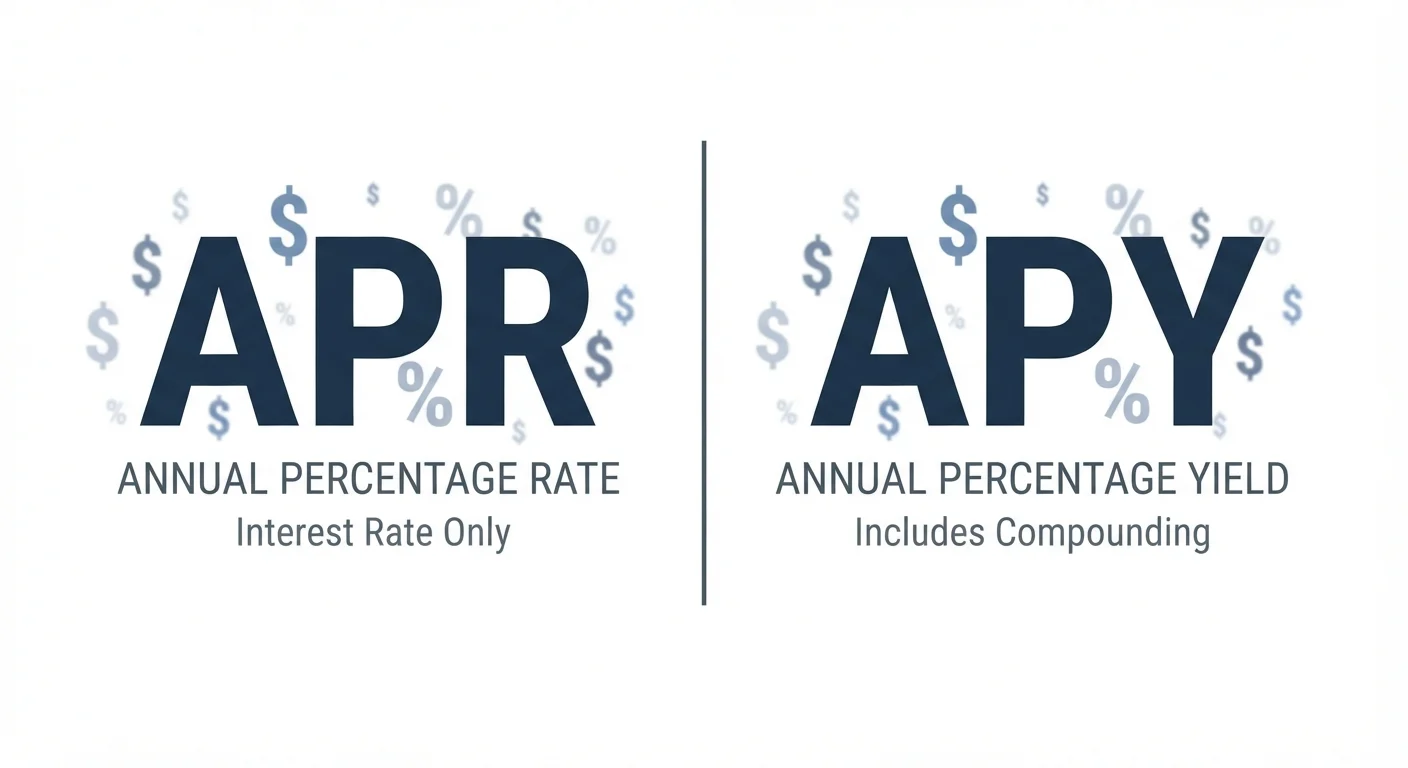
Photo credit: TrendingFaqs.com
In this article
APR and APY look similar but measure different things. See how each is calculated and when each figure is the one you should be reading.
Key Takeaways
- APR expresses the yearly cost of borrowing without accounting for compounding within the year.
- APY includes the effect of compounding, making it higher than the stated APR when interest compounds more than once annually.
- Lenders use APR on loan disclosures; financial institutions use APY on savings products.
- When borrowing, compare APRs. When saving or investing, compare APYs.
- A small difference between APR and APY can translate into meaningful dollars over a multi-year loan or savings term.
What APR actually measures
APR is the annualized interest rate on a loan or credit product, expressed as a simple percentage of the amount borrowed. It does not account for interest compounding within the year. On a credit card, for example, a 24% APR means the issuer applies roughly 2% of your balance each month as interest, but the APR itself does not reflect what happens when that monthly interest is itself charged interest in the following month.
Under the Truth in Lending Act (TILA), U.S. lenders must disclose APR when offering most consumer credit products, including mortgages, auto loans, and credit cards. This requirement exists so borrowers have a consistent number to compare across lenders. For mortgages specifically, APR often includes fees such as origination charges and mortgage insurance, which is why a mortgage's APR can be higher than its quoted interest rate.
When you see two loan offers with different APRs, the lower APR represents lower stated borrowing cost, all else being equal. That comparison only holds if both loans have the same term and fee structure, so reading the loan estimate carefully matters.
What APY actually measures
APY is the annualized rate of return that includes the effect of compounding. When a savings account pays interest monthly, that interest is added to your balance and then earns additional interest in subsequent months. APY captures this snowball effect in a single number.
The formula is: APY = (1 + periodic rate)n - 1, where n is the number of compounding periods per year. If a savings account has a 5% nominal rate compounded monthly, the periodic rate is 5% divided by 12, and the APY works out to approximately 5.12%. That gap between 5% and 5.12% seems small on paper, but on a $50,000 balance held for several years it adds up to a real difference in dollars earned.
Financial institutions are required under the Truth in Savings Act to disclose APY on deposit accounts, so consumers comparing high-yield savings accounts or certificates of deposit should use APY as the consistent comparison metric. A higher APY, with all other terms equal, means more money earned.
| Criterion | APR | APY |
|---|---|---|
| What it includes | Nominal interest rate only (plus fees on some loans) | Nominal rate plus compounding effect |
| Compounding reflected | No | Yes |
| Where you see it | Loans, credit cards, mortgages | Savings accounts, CDs, money market accounts |
| Governing disclosure law | Truth in Lending Act (TILA) | Truth in Savings Act |
| Higher or lower number | Lower than equivalent APY | Higher than equivalent APR |
| Best used for | Comparing borrowing costs | Comparing savings or investment returns |
How the gap between APR and APY affects real decisions
The difference between the two figures is not just a matter of calculation convention. It changes how you should interpret a rate depending on which side of the transaction you are on.
When you are the borrower, the APR understates the effective annual cost if interest compounds more frequently than once a year. Credit card balances compound daily in most cases, which means the effective annual rate you pay is higher than the stated APR. Converting to APY shows the true cost. For example, a credit card with an 18% APR and daily compounding carries an APY of approximately 19.72%.
When you are the saver, APY is the number that tells you what you will actually earn. Two accounts with the same nominal rate but different compounding frequencies will produce different APYs, and therefore different balances at year's end. Monthly compounding produces a higher APY than quarterly compounding at the same nominal rate.
The practical rule is straightforward: use APR when evaluating what borrowing costs you, and use APY when evaluating what saving earns you. Mixing the two in a comparison produces a misleading result.
This article is for general informational and educational purposes only and does not constitute personalized financial, investment, or legal advice. Consult a qualified financial professional for guidance specific to your situation.

Author
Finance Editorial Team
Finance Editorial Team is the collective byline for our editorial team and contributor network. Articles published under this byline or an editorial pen name are researched, written, and reviewed according to our editorial standards for clarity, consistency, and independence before publication.
View all articles →