
How the Cooling System Actually Keeps Your Engine from Overheating
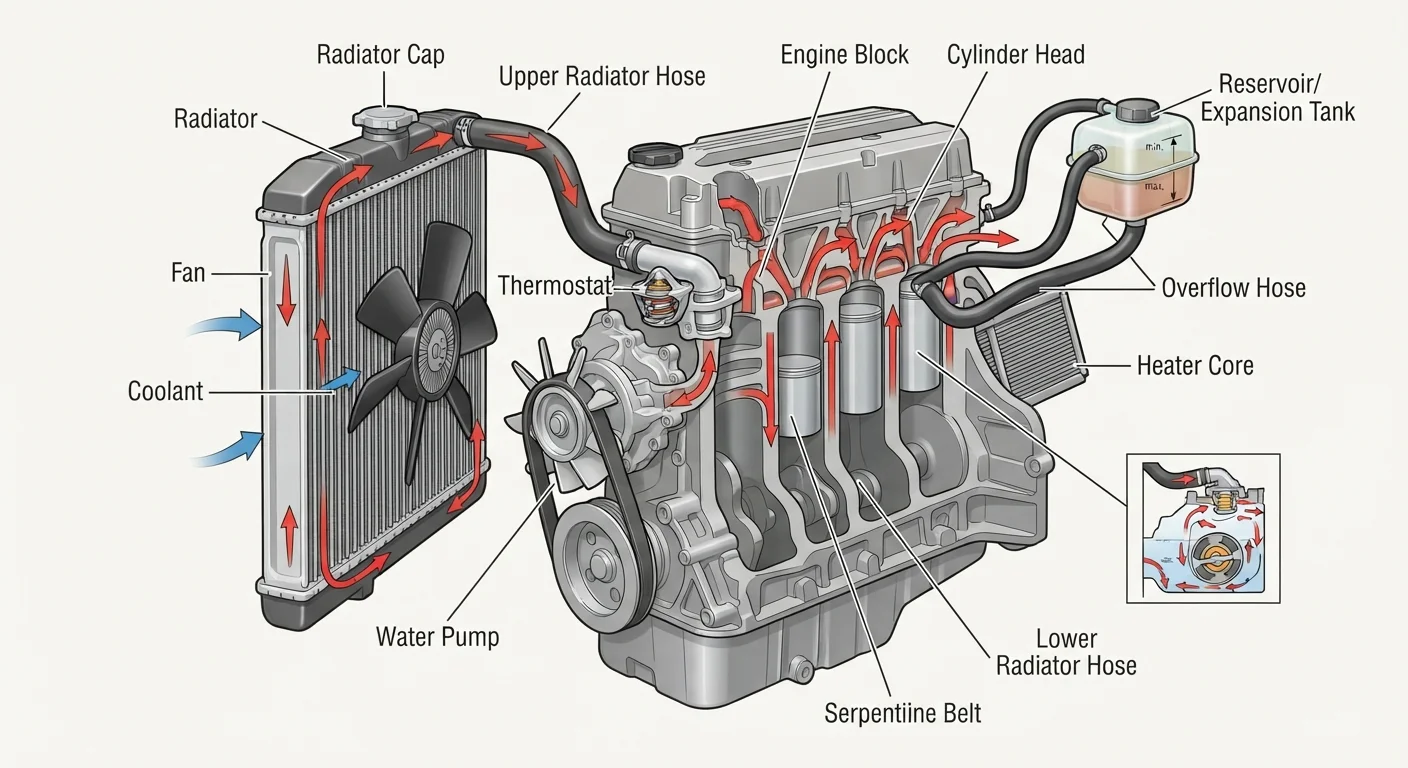
Photo credit: TrendingFaqs.com
In this article
Understand how your engine's cooling system works, what each component does, and why overheating is more preventable than most drivers realize.
Key Takeaways
- Coolant circulates continuously through your engine and radiator to absorb and release heat.
- The thermostat controls when coolant flows to the radiator based on engine temperature.
- A failed water pump or low coolant level is one of the most common causes of overheating.
- Overheating can cause severe, expensive engine damage in a short amount of time.
- Checking your coolant level regularly is one of the simplest ways to prevent a breakdown.
What the cooling system is actually doing
Your engine burns fuel to generate power, and that combustion process produces an enormous amount of heat. Left unchecked, that heat would destroy metal components in a matter of minutes. The cooling system exists to prevent that from happening.
The system works as a closed loop. A liquid mixture of coolant (also called antifreeze) and water travels through channels cast directly into the engine block and cylinder head. As it moves, it absorbs heat from the metal around it. The now-hot liquid is pushed out to the radiator, a flat grid of small tubes mounted at the front of the car. Air moving through the radiator's fins pulls the heat out of the liquid, and the cooled liquid returns to the engine to start the cycle again.
Every component in this loop has a specific job, and a problem with any one of them can break the whole system.
The main components and what each one does
Radiator: This is where heat leaves the vehicle. The radiator is a heat exchanger, a series of small tubes surrounded by thin metal fins. Hot coolant flows through the tubes, air passes over the fins, and heat transfers from the liquid into the air. A radiator fan helps pull air through when the car is moving slowly or sitting still.
Water pump: The water pump keeps coolant moving through the entire system. It is usually driven by the engine's serpentine belt or timing belt. If the water pump fails, coolant stops circulating and temperatures rise quickly.
Thermostat: The thermostat is a small valve that stays closed when the engine is cold, letting the engine warm up to operating temperature faster. Once the coolant reaches a set temperature, the thermostat opens and allows flow to the radiator. A stuck-closed thermostat causes overheating; a stuck-open thermostat makes the engine run too cool and reduces fuel efficiency.
Hoses and clamps: Rubber hoses carry coolant between the engine, radiator, and heater core. Over time, hoses can harden, crack, or collapse. A burst hose dumps coolant quickly and will overheat an engine within minutes.
Heater core: This small radiator-like component sits inside the dashboard. Hot coolant flows through it to warm the air that the heater blows into the cabin. A failing heater core can cause coolant to leak inside the car or fog up the windshield with a greasy film.
Never open the radiator cap on a hot engine
The cooling system is pressurized. Opening the radiator cap while the engine is hot releases that pressure instantly, causing coolant to spray out and potentially causing serious burns. Always wait until the engine has cooled completely before opening any part of the cooling system.
Overflow reservoir: As coolant heats up, it expands. The reservoir captures that overflow and feeds it back into the system as it cools. Checking this plastic tank is how most drivers monitor their coolant level without opening the radiator cap.
Why overheating happens and what it costs
195-220°F
Normal engine operating temperature range
Most gasoline engines are designed to run within this range, controlled by the thermostat.
~$1,500-$3,000+
Typical cost to repair a blown head gasket
Head gasket failure is one of the most common severe consequences of engine overheating.
Overheating almost always comes down to one of three causes: low coolant level, a failed water pump, or a stuck thermostat. Coolant can be lost through a slow leak at a hose connection, a cracked radiator, or a failing head gasket. Even a small coolant leak, if ignored long enough, leaves the system without enough liquid to manage heat.
The damage from overheating can be severe. A warped cylinder head or a blown head gasket are repairs that routinely cost thousands of dollars. In the worst cases, an overheated engine seizes entirely. The cooling system itself is not expensive to maintain, which makes those outcomes avoidable for most drivers.
For a closer look at coolant and the other fluids that keep your car running, see our guide to fluids under the hood.
Simple habits that protect the system
You do not need to be a mechanic to keep the cooling system in good shape. A few routine checks go a long way.
- Look at the coolant level in the overflow reservoir every month or so. The tank has min and max markings. If the level is consistently dropping, have the system inspected for a leak.
- Check the condition of your radiator hoses during oil changes. Squeeze them gently: they should feel firm but slightly flexible. A hose that feels hard, spongy, or cracked should be replaced.
- Follow your owner's manual on coolant flush intervals. Old coolant loses its corrosion inhibitors and can allow rust and scale to build up inside the system, restricting flow.
- Pay attention to the temperature gauge on your dashboard. It should sit near the middle in normal driving. Any sustained climb toward the red zone is a reason to pull over and get the car checked.
A mechanic can pressure-test the cooling system to find slow leaks that are not obvious during a visual inspection. This is a low-cost check that can catch problems before they become expensive ones.
Frequently Asked Questions

Author
Cars Editorial Team
Cars Editorial Team is the collective byline for our editorial team and contributor network. Articles published under this byline or an editorial pen name are researched, written, and reviewed according to our editorial standards for clarity, consistency, and independence before publication.
View all articles →