
Wired vs. Wireless Earbuds: What the Specs Actually Mean for Your Ears
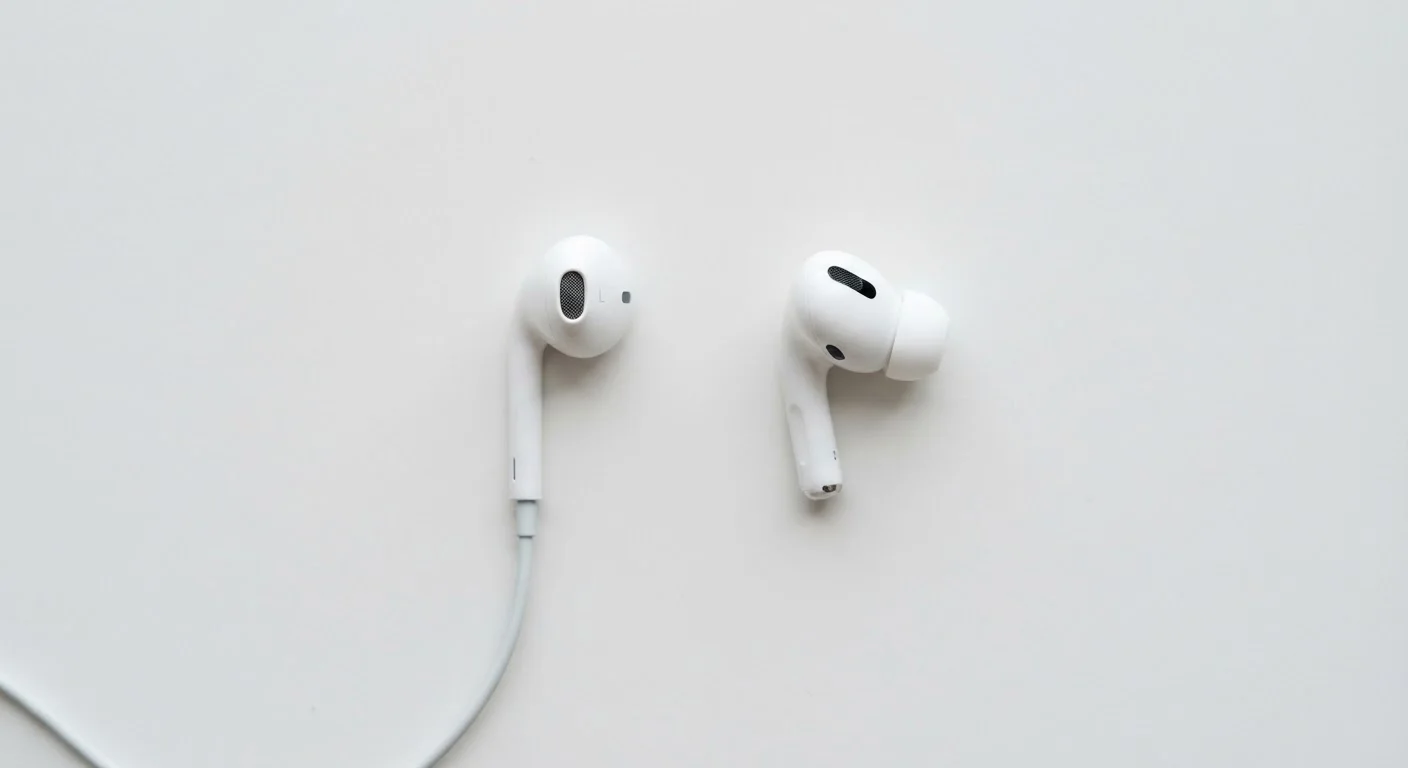
Photo credit: TrendingFaqs.com
In this article
A plain-language breakdown of latency, codecs, and battery trade-offs to help you understand what separates wired and wireless earbuds.
Key Takeaways
- Wired earbuds deliver audio with no latency and no battery to manage.
- Wireless earbuds rely on Bluetooth codecs that affect sound quality and lag between audio and video.
- Battery life in wireless earbuds typically ranges from 5 to 10 hours per charge, with cases extending that further.
- Wired connections pass audio digitally or as analog depending on the connector type, which affects compatibility.
- Neither type is objectively better; the right choice depends on how and where you listen.
How the connection type shapes what you hear
The cable in wired earbuds does two things: it carries audio data and it supplies the tiny amount of power the drivers need. Because the signal travels as an analog electrical wave along the wire, no conversion step happens between the source and your ear. The result is imperceptible latency, measured in microseconds rather than milliseconds.
Wireless earbuds work differently. Your phone converts audio into a compressed digital signal, transmits it over Bluetooth, and the earbuds decode it back into sound. That decode step introduces latency, typically between 100 and 250 milliseconds depending on the Bluetooth codec in use. For casual music listening that delay is not noticeable. For watching video or gaming, it can cause audio and picture to fall out of sync.
The connector on wired earbuds also matters. A 3.5 mm analog jack passes a ready-to-play signal. A USB-C or Lightning connector passes a digital signal, so the earbuds themselves contain a small digital-to-analog converter (DAC). The quality of that built-in DAC affects the final sound, though in everyday use the difference is modest.
What Bluetooth codecs actually do
A codec is the algorithm that compresses and decompresses audio for wireless transmission. The codec both devices share determines audio quality and latency. If your phone and earbuds do not support a common higher-quality codec, they fall back to SBC, the baseline Bluetooth audio standard.
| Criterion | Wired earbuds | Wireless earbuds |
|---|---|---|
| Latency | Near zero (microseconds) | 100 to 250 ms (codec-dependent) |
| Audio codec required | None | SBC, AAC, aptX, LDAC (varies) |
| Battery management | None needed | 5 to 10 hours per charge |
| Connector compatibility | 3.5 mm or USB-C/Lightning | Bluetooth 4.x or 5.x |
| Water resistance | Rarely rated | Often IPX4 or higher |
| Multi-device switching | Instant (unplug, replug) | Manual steps on most models |
| ANC availability | Uncommon | Common on mid-range and above |
SBC works fine for podcasts and casual listening. aptX and aptX Low Latency reduce the audio-to-video delay to roughly 40 milliseconds, close enough that most people do not notice sync issues. AAC, which Apple devices use by default, performs well on iOS but varies on Android because codec efficiency depends on how the phone's Bluetooth stack handles it. LDAC, developed by Sony, transmits at up to three times the bit rate of SBC, which can preserve more detail from high-resolution audio files.
One practical point: checking which codecs your earbuds and phone share before buying avoids disappointment. This information appears in the product specifications under "supported codecs" or "audio formats."
Battery life, charging, and the hidden trade-offs
Wireless earbuds carry internal batteries, and those batteries age. Lithium-ion cells lose capacity over charge cycles, so earbuds that last eight hours when new may last five or six after a year or two of daily use. Most manufacturers rate their earbuds at around 500 full charge cycles before capacity drops noticeably, though real-world results vary.
500
Typical charge cycles before capacity loss
Lithium-ion battery manufacturers commonly rate cells at roughly 500 full cycles before significant capacity degradation.
~250 ms
Maximum Bluetooth audio latency over SBC
SBC, the baseline Bluetooth audio codec, can introduce up to approximately 250 milliseconds of audio delay.
~40 ms
Latency with aptX Low Latency codec
aptX Low Latency reduces audio delay to roughly 40 milliseconds, making video sync far less of an issue.
Charging cases extend daily usability by storing extra charge, often enough for two or three additional earbud fills. However, the case also needs charging, which adds a second device to your power routine. Wired earbuds draw from the phone battery instead, adding a small drain to the source device but eliminating the separate charging habit entirely.
Active noise cancellation (ANC), if present, consumes battery at a faster rate. Manufacturers typically publish two battery figures: one with ANC on and one with it off. The difference is often 20 to 30 percent less runtime when ANC is active.
Fit, durability, and real-world use
Wired earbuds are mechanically simpler. Fewer moving parts means fewer failure points. The most common issue is cable damage near the connector or ear piece, where repeated bending weakens the wire. Using a cable wrap or storing earbuds loosely rather than tightly coiled reduces this stress.
Wireless earbuds contain more components in smaller housings: battery cells, antenna, codec processor, and microphones. That complexity can mean more to go wrong, though build quality varies widely. Water resistance ratings use the IPX scale; IPX4 means the earbuds can handle sweat and light splashing, while IPX7 means they can be submerged briefly. Wired earbuds are not typically rated for water resistance unless the product listing says otherwise.
Pairing behavior is worth considering for wireless earbuds. Most modern earbuds pair automatically when removed from the case, but switching between devices (a phone and a laptop, for example) can require manual reconnection steps depending on the product. Wired earbuds switch sources as quickly as you can unplug and replug the connector.

Author
Tech Editorial Team
Tech Editorial Team is the collective byline for our editorial team and contributor network. Articles published under this byline or an editorial pen name are researched, written, and reviewed according to our editorial standards for clarity, consistency, and independence before publication.
View all articles →