
Timing Belts and Timing Chains: What Sets Them Apart and Why It Matters
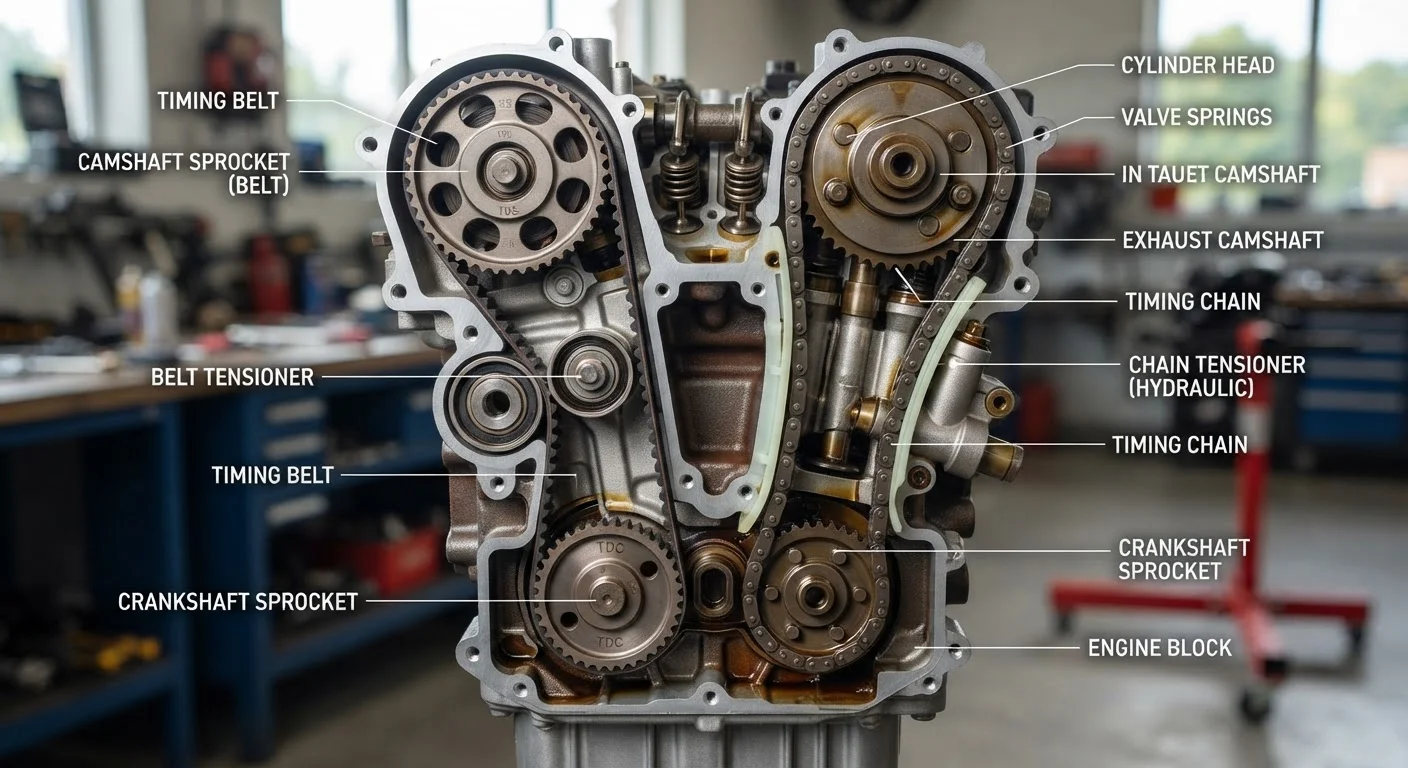
Photo credit: TrendingFaqs.com
In this article
Timing belts and chains both keep your engine in sync, but they age very differently. Here is what every driver should know about each one.
Key Takeaways
- Timing belts are made of reinforced rubber and must be replaced on a set schedule, typically every 60,000 to 100,000 miles.
- Timing chains are metal and generally last the life of the engine if the oil is changed regularly.
- A broken timing belt can cause severe engine damage in interference engines, often requiring costly repairs.
- Timing chains can wear or stretch over time, especially if oil changes are neglected.
- You usually cannot choose which system your car has; it is determined by the manufacturer.
- Knowing which system your car uses helps you plan maintenance and avoid expensive surprises.
What each one does
Both components do the same fundamental job: they synchronize the crankshaft and the camshaft so that the engine's valves open and close at exactly the right moment during each combustion cycle. If that timing slips, the engine runs poorly or not at all.
The difference is entirely in how they are built. A timing belt is a toothed rubber belt, usually reinforced with fiberglass or Kevlar cords. A timing chain is a metal roller chain that looks similar to a bicycle chain, looped around sprockets inside the engine. Because the chain runs inside the engine and bathes in oil, it behaves differently over time than a belt that runs dry in a sealed cover.
| Criterion | Timing Belt | Timing Chain |
|---|---|---|
| Material | Reinforced rubber | Metal roller chain |
| Typical lifespan | 60,000 to 100,000 miles | Lifetime of engine (with proper oil changes) |
| Replacement required | Yes, on a set schedule | Rarely, unless worn or damaged |
| Lubrication | Runs dry, no oil contact | Bathed in engine oil |
| Noise level | Quieter operation | Slightly more mechanical noise |
| Risk if it fails | Potential engine damage (interference engines) | Gradual warning signs before failure |
| Maintenance cost pattern | Predictable scheduled replacement cost | Low routine cost; higher if neglected |
How long each one lasts
Timing belts have a manufacturer-specified replacement interval, typically somewhere between 60,000 and 100,000 miles, though the exact mileage varies by vehicle. Time matters too: even a low-mileage belt can dry out and crack after several years, so most manufacturers also give a calendar limit, often around seven years. Skipping this replacement is one of the more costly mistakes an owner can make.
Timing chains carry no standard replacement interval because they are intended to last the engine's lifetime. That said, they are not indestructible. A chain can stretch or develop slack, and worn tensioners (the spring-loaded devices that keep the chain tight) can let it rattle or jump. Neglecting oil changes accelerates this wear because the chain depends on clean, pressurized oil to stay lubricated and to keep the tensioners working properly.
What happens when something goes wrong
A failing timing belt usually gives little warning. When it snaps, the engine stops immediately. In what engineers call an interference engine, that sudden stop can allow pistons and valves to collide, destroying both. Replacing a seized interference engine costs far more than a routine belt replacement. Non-interference engines are less vulnerable to catastrophic damage if the belt breaks, but the car still stops and will not restart until the belt is replaced.
A worn timing chain tends to announce itself gradually. A rattling or clattering noise from the front of the engine at startup, before oil pressure builds, is a common sign. The engine may also trigger a check-engine light related to camshaft position or variable valve timing faults. Catching these symptoms early typically means a tensioner or chain replacement, which is a significant job but less severe than a belt failure in an interference engine.
Interference vs. non-interference engines
In an interference engine, the space the pistons travel overlaps with where the valves open. If timing slips or the belt breaks, pistons and valves can collide and bend or break. In a non-interference engine, those paths do not overlap, so a belt failure stops the car without guaranteeing internal damage. Your owner's manual or a mechanic can tell you which type your engine is.
How to find out which one your car has
Your owner's manual is the first place to look. If the scheduled maintenance section includes a timing belt replacement at a specific mileage, your car has a belt. If no such service appears, the engine likely has a chain. You can also search your vehicle's year, make, model, and engine size alongside the phrase 'timing belt or chain' to confirm. A qualified mechanic can verify it in person as well.
Once you know which system your car uses, the path forward is straightforward. For a belt, find the replacement interval in your manual and track it against your current mileage and the age of the belt. If you bought the car used and the service history is incomplete, a mechanic can inspect the belt's condition and help you decide whether replacement is due. For a chain, consistent oil changes at the interval your manufacturer specifies are the main thing standing between you and early chain wear.
This article is for general informational purposes only. Consult a qualified mechanic for diagnosis or repairs specific to your vehicle.

Author
Cars Editorial Team
Cars Editorial Team is the collective byline for our editorial team and contributor network. Articles published under this byline or an editorial pen name are researched, written, and reviewed according to our editorial standards for clarity, consistency, and independence before publication.
View all articles →